Contract Airline Services


"We are the protagonists of our stories called life, and there is no limit to how high we can fly."


PHD. MBA. MHS. Type rated on A350, A330, B777, B747-400, B747-200, B757, B767, B737, B727. International Airline Pilot / Author / Speaker. Dedicated to giving the gift of wings to anyone following their dreams. Supporting Aviation Safety through training, writing, and inspiration. Fighting for Aviation Safety and Airline Employee Advocacy. Safety Culture and SMS change agent.

Friday, August 16, 2013

Bill Palmer

Friday's Fabulous Flyer

 Captain Bill Palmer

Bill started flying lessons when he was fifteen years old in a Cessna 150 on a small grass strip in central New Jersey, and soloed on his sixteenth birthday. He earned his pilots license when he was seventeen. His mother actually drove him to the airport because he did not have a drivers license.

He received his commercial, instrument, multi-engine, cfi and CF-II, while attending Embry Riddle in Daytona Beach. During the summer of his junior year he instructed at that grass field where it all started. 

Bill graduated from ERAU with a BS Aeronautical Science in 1979, and went to work for a Beech dealer in Pontiac Michigan where he earned his milti-engine instructor certificate. He put that ticket to work... but also flew charters in Barons, and was an FO on King Air.

Aerostar

He also flew cancelled checks around at night, single pilot, single and multi-engine. He says it was a great experience, and at one point flew eight hours a night, four nights a week in an Aerostar. Talk about building time and experience.

In 1982, he found himself flying BE-99's for Air Kentucky airlines, an Allegheny commuter (the USAir regional at the time). More than flying, he wrote a computer program for processing the airline’s tickets, and created a passenger information brochure. When the first printing could not be used because of copyrighted art of the airplane for the cover, he made a pen & ink drawing of the airplane himself.


Then in February of 1984, he was hired by Northwest, and his career took off. He started as a B727 second officer, then second officer OE instructor, and first officer. And so it went...


He was a 757 first officer instructor, classroom instructor, fixed base simulator instructor, and wrote training articles. He also created the ventilation schematic that remained in use for over twenty years.


A320. He was a simulator insrtuctor, flew the airplane, was an line instructor, an FAA designee, and wrote articles and made training videos. 


DC-10. He was the lead on DC-10 systems manual rewrite, and learned FrameMaker. He was an instructor, flight test pilot... delivery and autoland systems, and worked directly with engineers on a simulator rehost project.


A330. Development team, lead on systems manual, taught FrameMaker. Was a simulator and OE instructor, and a FAA designee. He authored various training materials, an created an ACARS simulator. He also flew formation with a lear jet for the photo flight against the rocky mountains. Most importantly, he was my simulator instructor on the A330!


787 development team, he was the lead on systems manual creation and development tasks. He was also type rated in the 777 while working on a 787 project. And then during the merger he worked on joint training projects between airlines.

As if all this wasn't enough... In 1991 he began flying gliders in Minnesota, and earned his commercial certification in 1992. He stopped flying gliders in 1995, but picked it up again in 2012 and now flies out of Warner Springs CA. He developed and programmed an on-line store for his glider instructor. Check out bobwander.com (Where I bought my books.)

He also created a written-test preparation program that was sold for glider & airplane FAA tests, the glider bronze badge written test, and as a study guide for DC9, 727, 757 and A320.


Bill is a webmaster and video producer DIYplumbingAdvice, and several other web projects. He is a house corporation trustee for his college Fraternity’s house corporation (ΣX) and developed and programmed his chapter’s website and on line database. He is the developer and programmer of Glidersource.com, a soaring classified ad website.


Bill and his lovely wife Mary, live on a small horse farm in rural southern California where he drives a tractor, taught himself how to torch weld, and likes playing the drums.  He's got two horses, 3 dogs, 2 cats, 2 parrots, 3 chickens & feeding about 200 hummingbirds.

As if you thought I was busy~ So what is Bill up to now? 

He just wrote a book, Understanding Air France 447.  The title speaks for itself. But join us next Tuesday with an interview with Bill to hear the story behind the story. We'll learn more about this book and why it came into being. There is always a story behind the story. For now... check it out. You will not be disappointed! 


And if anyone has an technical question ask Bill. 
There nothing he doesn't know about the A330.


It's kind of funny the things that impact our lives. Bill shared something with me that was interesting, and definitely impacted his. He said, "When I sent one of my first primary students for his check ride, and I went to meet the examiner (so this is 1978) he told me that if I gave my students limits (e.g., 100 ' 10°) they'll exceed them, but if I demand perfection, I'll get it." 

What words of wisdom have impacted your life? 

You can follow him on Twitter @wfpalmer 
And follow his blog at TrendVector

Enjoy the journey!
XO Karlene

Thursday, August 15, 2013

THE ARTISTRY OF FLYING

T.H.ursdays with Tom Hill

I struggled a little bit this week figuring out what to write about. I keep a list on my iPhone of ideas for subjects. When I think of a possibility, I write it into my phone for review later. Mostly, my ideas for what to write about simply come as I start putting "pen to paper." Today is no different. I wanted to write something about every pilot being exposed to acrobatics and other dynamic maneuvering. As I started to type I thought, "Let's talk more about the basics of why such training is important." That led me to think about today's topic, which is how flying is artistic.


I had a supervisor, the Commandant of the USAF Test Pilot School, say something about flying that was very insightful. He was an engineer, the only engineer to hold that distinguished position. Being the supremely intelligent man that he is, he would ask basic questions about the nature of flying that we pilots mostly took for granted. On this day he asked for my thoughts about whether I thought flying, specifically piloting, was by its nature artistic. I hadn't thought of that before but immediately made the connection.

I believe it is. As many controls, regulations, rules, and automation we might put into flying, at its core, piloting aircraft is artistic to the same degree as painting, playing an instrument, or being a photographer. Each of those vocations can easily be regimented--e.g. paint by numbers--but we rarely discount their connection to being artistic. Piloting, on the other hand, is not commonly connected to an artistic nature.

All of us have been to airshows and watched the headline demonstration team show off their skills. As much as I ooo'd and ahhh'd at their shows as a kid, I developed a new level of appreciation when I learned to fly at pilot training. After I learned the basics of aviation, a new window to the details of flying such demos opened up. The dozens and dozens of considerations, analyses, and decisions that go on every moment during such a demo are mind-boggling. Something as routine as quickly rejoining far flung aircraft involves amazing numbers of considerations and aircraft parameters to be worked through. Yet, these teams do these things so expertly as to make it look simple to the casual observer. We pilots know differently. With so many variables at play, it takes a good dose of "seeing" the solution to make these things happen. "Seeing" is a pretty necessary skill for any artist.


When I was the Edwards AFB F-15 demo pilot, the flight profile I flew was very scripted. Everything about it had parameters that had to be met to ensure proper safety margins were always in-play. To the outside uninformed observer, the long list of airspeeds, altitudes, and aircraft conditions were totally transparent. Yet, as pre-defined the profile was, it took a level of "expertise" to tackle the profile expertly. Even with all the pre-planning weather conditions would creep in requiring adjustments to the parameters to keep the profile as perfect for the viewer as possible. It was always the little things that made one demo flight better than the next. It's the same as a virtuoso playing a classic arrangement many others played before. Artistry is at work.

Some people out there may not understand how I can connect flying to artistry. Some of them might think flying as simply a matter of procedure. They may think flying is simply a matter of making planes idiot proof, training only a matter of learning perfect procedure, and discipline merely doing the right cookbook procedure at the right time. This might make sense in some situations but if you never understand the limits of such a perspective you're doomed to be surprised when things don't go right. If you know and understand that flying is more than simple procedures, there's a hope you might "see" solutions for unexpected situations. Artistry like flying is about developing great skill.

Artistry is a funny thing. It's so difficult to put a finger on what art is. Like anything that's based on subjectivity, it's hard to define quantitatively. But, just because something is hard to define quantitatively and is difficult for actuaries and accountants to accept, it does not mean it's not important. In fact, artistry might be the most important thing of all.


Cheers
Tom
www.tom-hill.biz 
Thank you Tom! This could not be a better week for this post. Monday we had the art of soaring, Tuesday is the art of giving back. Wednesday Aviation Art. And today... your beautiful piece on the Art of flying. Tomorrow another pilots makes art of another kind.

I can totally see how you can connect art to flying. I've flown with artists who paint the sky, and have flown with those who operate mechanically. There is a difference. 

Enjoy the journey!
XOX Karlene

Wednesday, August 14, 2013

Captain Mike Challgren

Aviation Artist


I recently connected to an aviation artist, Mike Challgren who is making incredible sculptures. A captain of a different kind, who builds planes instead of flying them. Mike started out in Burbank as an airport policeman, then became a captain, and quickly developed a love for aviation.


"I was captured by the aircraft, the stories, the pilots, the history, the industry. I met a lot of aviation people and loved every minute of my airport day. I listened to stories from pilots, even test pilots. I had a morning conversation with stunt pilot Frank Tallman – “Flying the Old Planes”, an aviation great."


"I met Tony LaVier, Lockheed P38 test pilot. Later, I moved to the Airport Maintenance Division. My love for aviation grew as I studied the FAR’s and Advisory Circulars and managed to make the airport a safer place. I was present as the SR 71 made 3 low passes over R/W 15 at BUR, the last pass with the after-burners lit. Awesome! My story continued as I travelled to several airports doing construction work for the airlines and became a frequent flyer."


"Early on, I transferred one of my unique talents to the aviation world. I have the ability to make anything you can think of out of welding rod. I made my first aircraft, a Falcon 20, and then my second, a DC-3, then a B 727 – which I sold, to a PSA Captain. He loved it and had me make several more for his friends. That’s how I started."


"The quality of my work has grown with the quality of the real aircraft. Grumman Gulfstream aircraft are my specialty. I have done ‘fleets’ of G550’s, and lately G650’s. You can see an unfinished G650 on my profile page."
 

Please take a moment to check out Mike's website at WireSculptor to see more samples of his work. He tells me he is able to produce an accurate rendition of any aircraft.  
 
Which one do you want?
 
 
"My sculptures are very attractive and valued by people who have received them. I fix the wire model to a welding rod base so it sits securely on a desk or a shelf. I can also personalize each sculpture with special requests ie; N#, make and type of aircraft, a person’s name, flying status, business card holder etc."


His work looks pretty awesome. I know I will be connecting to get a plane of my own. Now I just need to decide which one. Which plane do you want?

Enjoy the Journey!
XO Karlene

Tuesday, August 13, 2013

Pilot Gives Back to Community

Mark Berney, a pilot from SkyWest Airlines, and I connected last year at the Women in Aviation conference. He was interested in the flying events we hosted in Seattle, as he was planning one of his own. But his flying club is unique, as they were hosting their event for local foster kids.


I had wanted to go talk to the girls during their event, but was unable due to that commitment called work. But I hope we will see this fabulous event again next year, and I will block off the month to make it happen. 


This aviation camp was a huge success. They had beautiful weather, and took the kids flying. I had asked Mark if he would share with us what they were doing, and what this meant to the teens. Here you go...

"What does it mean to be a foster care teen? How would these young people react to the airport environment? Would there be fear and meekness, or an underlying strength since they'd been more self-dependent at an early age? I could guess, but I didn't really know. These were my thoughts as I prepared the conference room at the Bremerton National Airport for the imminent arrival of ten teenage foster care girls, their camp councilors, and a significant group of support staff.


Teen Reach Adventure Camp, or TRAC, is an orginization that provides three day camp experiences to teens in the Foster Care system. The Kitsap Aviation Squadron, KAS, is a longstanding flight club of 30 pilots and two Cessnas based in Bremerton. For the first time, day one of TRAC would include a visit to the airport and introductory flights for all the campers and councilors, courtesy of KAS pilots.

At 1:00 pm sharp we spotted the yellow bus as it rolled into the airport parking lot. A high, thin overcast veiled the blue sky, but calm winds and great visibility gave the promise of smooth, enjoyable rides. The campers filed into the airport conference room, and it was clear that these bright, capable girls possessed a mix of courage, excitement, and a touch of nerves at the prospect of their first flight in a light aircraft.


Flyers were introduced to their pilots, and the first two flights were dispatched. Soon both aircraft departed and disappeared over the tree line. Twenty quiet minutes passed for those of us on the ground. Curious questions were asked and answered. One aircraft descended back into the airfield, followed closely by the second. The first flyer back through the doors was greeted by a round of applause! "I landed the airplane!" She nearly squealed. The campers excitement began to build and pilots swelled with satisfaction knowing that the ranks of those enamored by flight had swelled just a bit.

The tone of day was now set. A total of eight flights departed, and were met by applause upon return. As feet hit the ground post-flight, reactions ranged from the dance of joy to the kneal and kiss the ground act for the sake of onlookers! At the end of the day 10 campers were sent on their way with a fantastic experience under their belt, and with broadened horizons. When asked who would become a pilot, four responded with a determined affirmative!


Thanks to the dedicated TRAC staff, and the folks of KAS, the day was a complete success!

A huge thanks is due to Jim Swartwood, Jay Villalva and Steve Jennings for donating their time to fly the kids. Thanks also to Steve Charbonneau, KAS president, and John Wells, KAS Treasurer, who spent the day supporting the event, and spending time with the campers as they waited their turn to fly."


-Mark Berney, KAS member and event coordinator.

Being a teenager is a tough time as it is. Then to be in the foster care system, and the feeling of someone not wanting you, well...that's got to compound this challenging time. But to climb into a plane is a powerful thing. To fly even more so. This was an opportunity of a lifetime for these girls. And I suspect Mark and his team changed some lives in the process. A HUGE thank you to Mark for coordinating this event, to all the pilots and everyone who made the effort to make this event a huge success.

Mark and his son who is now 14


Enjoy the journey and find a way to make a difference!
XO Karlene

Monday, August 12, 2013

Spread Your Wings and Fly

Monday Motivation


"You may not know where you're going, but you know that so long as you spread your wings, the winds will carry you.”


I have decided to spread my wings to find a solution for the three primary problems facing aviation today. If you have not heard what I'm doing... click the Future of Aviation. 

“In the automated world we now live, glider flying will be far more beneficial acquiring aerodynamic skills and a scan. This will produce a generation of pilots who can fly a plane beyond managing the computer. They will build a solid foundation.”

This will also be the foundation of my thesis as I earn a Ph.D. in Aviation Safety.


But today is about a reaction to the inspiration of flying gliders as a solution to our future. After posting that article, all sorts of comments popped up. I have to admit, the following comment is one of my favorites. Please welcome Swayne, and soar with the inspiration of this young man


Swayne Martin

--------------------------------

After reading your article, and being in Lake Tahoe for vacation this summer, I thought it would be the perfect opportunity to see what glider flying is all about. Truckee, California and the surrounding mountains are known for fantastic gliding. I scheduled my first glider lesson with Soar Truckee, out of the Truckee-Tahoe Airport (KTRK), for an hour, on August 3rd. I was nervous and excited to try a completely different type of flying.


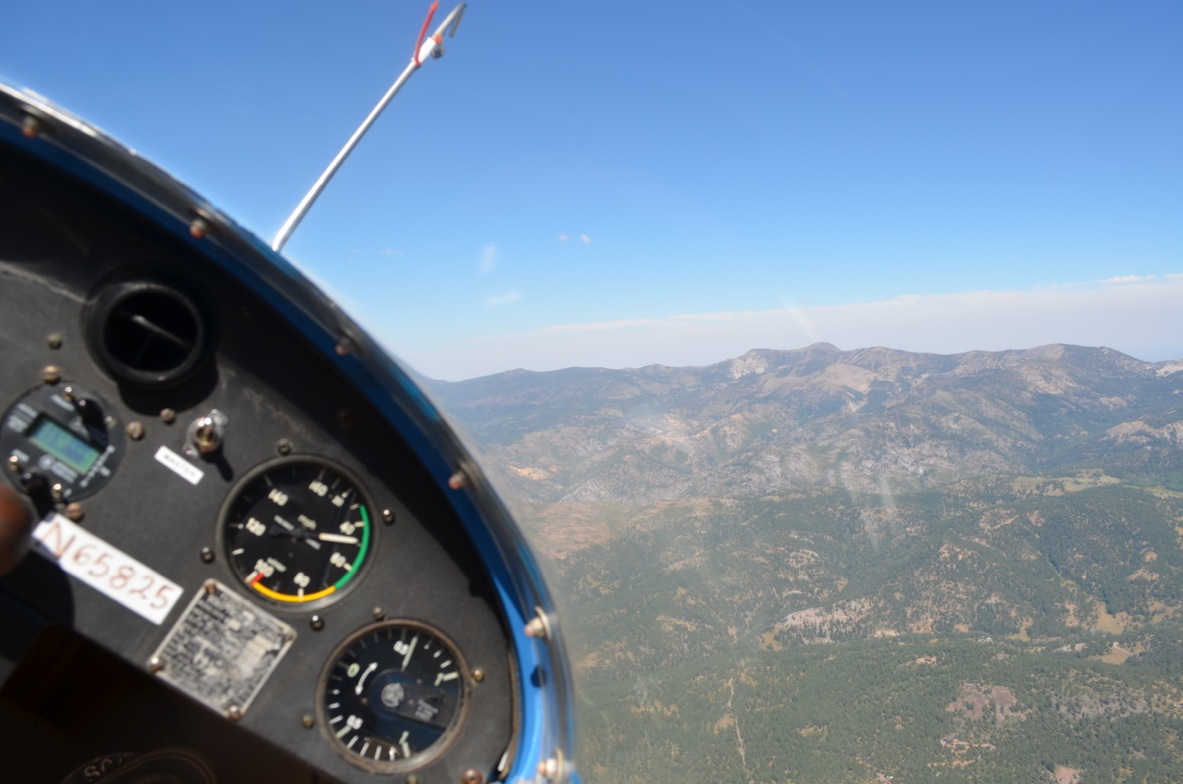
We were to fly in a Schweizer SGS-2-33 (N65825). This training glider first flew in 1965. It is nearly 26 feet long and has a long wingspan of 51 feet. This glider doesn’t exactly look like the modern, swooping gliders that many people envision.


Before I knew it, I was getting all strapped up into the glider and got my GoPro Camera set up on the canopy. Right after I closed and locked the canopy, we were on the roll! One really cool thing about flying in a glider is that you will be in the air often before the tow plane is!


The first thing you'll notice flying in a glider is how quiet it is. After having done all of my training in a powered aircraft, it was completely different flying in something without an engine. We were released at about 9,000 feet (3,500 feet AGL) and eventually climbed through thermals to an altitude of nearly 14,000 feet! That's almost at the point when oxygen is required!


I would be lying if I said all went well for me during the flight. I got pretty nauseous from the spinning, which was required to fly up the tight thermals. There wasn't a whole lot I could do about it besides look at the horizon and breath deeply. When we would fly straight for a period of time, that bad feeling would go away.


After reaching nearly 14,000 feet, the instructor got me to take control and feel the way the glider would fly. Because I wasn't flying in any thermals, we descended a few thousand feet over a period of time. At that point, it was me who was going to do some thermal flying. One strange thing for me was that I felt a lot better spinning if I was the one in control. My body could expect what was coming motion-wise. I didn't ever really feel bad when I was the one doing the thermaling.


That said, the views of Lake Tahoe, Donner Lake, and the surrounding mountains were incredible from 14,000 feet. I loved being able to see many of the places I grew up vacationing in from a different perspective! It was especially cool to be circling up a thermal with 2 or 3 other gliders!


After exactly 1 hour of flight, it was the right time to head back to the airport. Going through the pattern and landing was pretty interesting. Being in the front, I controlled the spoilers when he would ask for them, other than that, all of the controls were with Jan. When you're in a glider, you come in high to make sure you have enough room to land safely. Touching down, we pulled off to the left into the pullout area and leaned the plane forward, where the brakes are located.


Overall, I had an amazing first glider experience. Getting used to the thermaling took awhile, but it wasn't anything too bad. I would recommend Soar Truckee to anyone in the Lake Tahoe area. The people are so welcoming and always want you to have a good time. I promise you won't regret taking your first glider flight! The “stick skills that you’ll develop are extremely valuable!

---------------------------------


So back to Karlene’s proposition… After experiencing my first glider flight, I now see what everyone has been saying about how gliding improves your “stick skills.” I truly believe that even after only 1 hour of flying, I got a great feeling for how thermals work and feel. The “bad” feeling I got from thermaling/spinning wasn’t really “typical” for someone to feel. It was a combination of our very high altitude, the fact that I was with an ex-fighter pilot, and that we were in an older bird. Even with that, I’m still hoping to move on sometime and get a glider’s license – that’s how much I think it would help develop my own skills as a pilot.


The flight I took was cheap in comparison to how much it would’ve cost to do a powered flight up there. Technically, because there are thermals, we could have stayed up for many more hours. Once one has the license, they could pay for a tow up charge, and a low rental fee, and fly for hours and hours!


So, in conclusion, I think that Karlene’s proposition could be a very legitimate one. What could be better? – You’d be training better, safer pilots, in a MUCH more cost-effective way!


For those of you who may not know who I am: My name is Swayne Martin, I’m a student pilot out of Richmond, Virginia, who created the website “From Private to Professional Pilot” - http://martinsaviation.blogspot.com/. I now have over 20 hours flight time, in 8 different aircraft. I soloed when I turned 16, after 4.5 hours of flight time. In addition, I just recently completed my first cross-country (point A to point B over 50nm) flight with 14 hours flight time. The mission statement of my website is as follows:


“The goal of my blog is to show the steps which I will be taking over the next few years in my pursuit of a Professional Pilot career. I show step by step my path towards this goal, beginning with my first Flight Lesson. In addition, I will show you what inspires me in aviation from the people I have met to the flights I have taken. Along the way, I hope to inspire young or new pilots to follow their passion and take it to the next level.”

Swayne, thank you for the great post. So a bit of trivia… I drove past this exact location numerous times a few months ago. I had said to my husband, “I want to go fly a glider there!” But time was not our own, as we were babysitting our grandkids, and taking them to and from the wedding venue, and then needed to hit the road early to drive to Seattle. So I didn't at that time. But I will.

What do you think about this idea? 
Have you been inspired to fly a glider? 

 
All photos and videos compliments of Swayne Martin.

Enjoy the journey! 
XO Karlene

Friday, August 9, 2013

Dusty Crophopper

Friday's Fabulous Flyer 

Dusty Crophopper

Dusty is a plane with lofty dreams and high hopes. A crop duster by trade and a single-prop plane, he dreams of soaring alongside his high-flying heroes in an international race. The fact that he’s not really built for competitive racing doesn't deter him from pursuing his dreams. But his fear of heights just might.


With a little help from his friends—and a WWII vet with wisdom to spare—Dusty takes off on an adventure of a lifetime, flying prop-to-prop and wing to wing with champions. He dares to reach heights he never imagined possible, and learns that nothing is impossible if you dream big and never give up.


Karlene: Dusty I know you have big dreams, but can you tell us what you were built to do?

Dusty: I’m a crop duster. I help grow corn for ethanol. Dusting crops is all right, but when I’m flying   back and forth across the same field each day, I sometimes imagine that I’m doing something else. 


Karlene: You imagine doing something else? What could a crop duster possibly dream of doing?

Dusty: I want to compete in the Wings Around the Globe Rally. It’s this big race I’ve followed on the RSN Network for years. Chug and I like to hang out and watch these amazing racers show off their speed and agility. It’s like poetry in the sky, y’know what I mean? 

I know I can race. I have a tight turn radius and a high power-to-weight ratio. I KILLED the treeline moguls during training last week. I could be a contender.


Karlene: I have no doubt you could be an awesome racer. So... which racers do you most look up to?

Dusty: Whoa—that’s a tough one. They all have such unique style and form. I mean—Ripslinger’s a legend. The Green Tornado! He’s won more races than I’ve dusted cornfields, which is saying a lot. Bulldog is a diehard. Tougher, younger planes can’t seem to beat that guy. El Chupacabra has more passion in his landing gear than most planes can muster in a lifetime. But I’ve always been a fan of the female racers. Rochelle from the Great White North, eh? [laughs] And Ishani… she’s pretty—talented. 


Karlene:  Dusty, I know a woman who can fly without arms. But seriously, you’re clearly not built to race—how can you compete with top racers like Ripslinger and Bulldog?

Dusty: Maybe, just maybe I can do more than what I was built for. Doesn’t everybody want that at some point? Well they should. 


Dusty: I have a few tricks up my wing. My team, for one. Dottie—my mechanic—is the absolute best. She knows me inside and out. I think she’d prefer I keep it low and slow—for health reasons—but she’s got my back when it comes to racing. 


Dusty: Chug is the best buddy a plane can have. He’s been my coach for years, too, and some days he has more confidence in me than I have in myself. Then there’s Skipper. He’s this Corsair who knows more about flying than any plane I’ve met. He’s tough. Relentless, really. But I don’t mind because he knows what he’s talking about.


Karlene: You've got some great friends and role models to help lead the way. Which leg of the race are you most excited to take part in?

Dusty: All of them. Iceland, Germany, India, Mexico. They’re like foreign countries to me. I hate to admit it, but Propwash Junction is all I know. Planes like Skipper—well they’ve seen the world. I’ve never had the chance. Till now, that is. And I intend to soak up everything I can if I qualify for the race—I mean, WHEN I qualify for the race… and then follow that by winning the race. Right? 


Karlene: Right! Dusty, I've flown to all these places and at one time I was told I couldn't fly because I was a girl. Heck, if a girl can fly a crop duster can surely race! Did you know that Delta Air Lines started out as a crop dusting service? Yep! And look at them now. The leader of all airlines and they carry zillions of people daily to places all around the world! Also, did you know that many pilots are afraid of heights too? I am. So don't let that stop you. Don't let anything stop you.


I have no doubt you can do anything you believe in. Keep dreaming, and never give up my friend! We are all counting on you. And congratulations on your new movie. Remember... 


PLANES TAKES OFF TODAY
August 9th
Happy Birthday Mom!

"From above the world of “Cars” comes “Disney’s Planes,” an action-packed 3D animated comedy adventure featuring Dusty (voice of Dane Cook), a plane with dreams of competing as a high-flying air racer. But Dusty’s not exactly built for racing—and he happens to be afraid of heights. So he turns to a seasoned naval aviator who helps Dusty qualify to take on the defending champ of the race circuit. Dusty’s courage is put to the ultimate test as he aims to reach heights he never dreamed possible, giving a spellbound world the inspiration to soar. For more information, check out Disney.com/Planes, like us on Facebook: facebook.com/DisneyPlanes and follow us on Twitter: twitter.com/DisneyPictures."

(click above to read more)

Enjoy the journey and the popcorn!
XO Karlene